
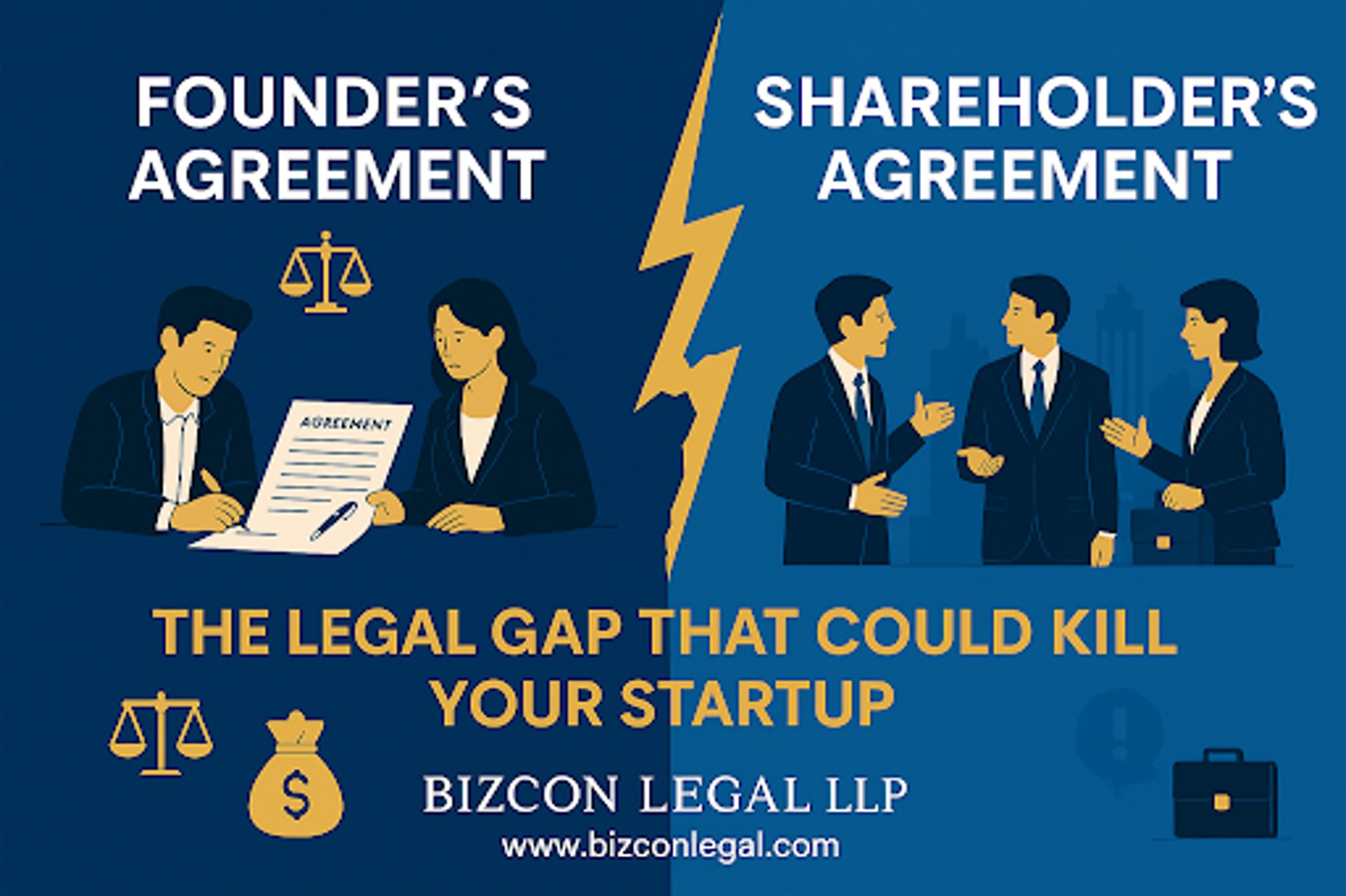
Founder’s Agreement vs. Shareholder’s Agreement: The Legal Gap That Could Kill Your Startup
BLL-STARTUP-002-2025
7/24/2025
Founders, Investors, Lawyers—Everyone Gets This Wrong (But You Won’t)
Know the Difference between Founder's Agreement & Shareholder's AgreementIn the early excitement of launching a startup, founders often pour their energy into building the product, crafting the pitch, and attracting early users. Legal paperwork? That usually gets pushed to the back burner—until things go south. One of the most common and damaging oversights is the confusion between a Founder’s Agreement and a Shareholder’s Agreement.
Many treat them as one and the same. They’re not. While both documents govern relationships in a company, their purpose, timing, and legal force differ significantly—and misunderstanding this can destroy a startup from the inside.
What Is a Founder’s Agreement?
A Founder’s Agreement is the first legal foundation of your venture. It is typically signed before incorporation or immediately after, by the co-founders of the startup. Think of it as a prenup for business partners. It defines each founder’s roles and responsibilities, equity ownership, intellectual property (IP) contributions, decision-making process, vesting schedules, and exit protocols.
For example, if one founder walks away in six months, does he still retain 25% equity? A well-drafted founder’s agreement ensures clarity on such matters. This was notably absent in the dispute among Housing.com’s co-founders, where lack of structured internal understanding led to conflicts and exits that could have been handled more smoothly.
Real Case Insight: In the Housing.com saga, internal strife between co-founders due to the absence of a formal Founder’s Agreement led to public fallouts, exits, and eventual leadership changes that destabilized the brand.
A Shareholder’s Agreement is entered after incorporation, once shares are issued. It governs the relationship between shareholders, which may include founders, investors, employees with ESOPs (Employee Stock Ownership Plans), and others.
A Shareholder’s Agreement comes into play after the company has been incorporated and shares have been issued. The SHA is more about ownership, control, and governance. It defines how shares can be sold, transferred, or inherited; how board decisions are taken; and what rights minority shareholders have.
Landmark Case: In VB Rangaraj v. VB Gopalakrishnan [AIR 1992 SC 453], the Supreme Court ruled that any restrictions on share transfers must be incorporated into the Articles of Association (AoA) to be enforceable. An SHA alone is not enough.
The Tata Sons v. Cyrus Investments Pvt. Ltd. case is a textbook example of corporate governance gone wrong. The lack of clearly defined rights in the SHA and ambiguity in board governance led to intense litigation, eventually culminating in a Supreme Court ruling that clarified the balance of power between majority and minority shareholders.
It’s critical to understand that while both agreements are legal contracts, a founder’s agreement is governed purely under contract law, whereas a Shareholder’s Agreement has to work in tandem with the Companies Act, 2013, and the company’s constitutional documents. This becomes especially important during investor rounds or exits.
One more layer of legal complexity arises when we talk about disputes.
In Satyam Infoway Ltd. v. Siffynet Solutions Pvt. Ltd. (2004 AIR SC 3540), the court, while dealing with IP and brand rights, touched upon how founders’ roles and contributions—when not contractually defined—can lead to disputes that are hard to resolve.
Similarly, in the Tata-Mistry case (Tata Sons v. Cyrus Investments Pvt. Ltd.), the lack of clarity in shareholder rights and board governance became a hotbed of conflict, eventually leading to a landmark judgment by the Supreme Court which redefined corporate governance dynamics in India.
The biggest mistake startups make is assuming one document can do the job of the other. A founder’s agreement helps the team stay together and avoid internal clashes. A shareholder’s agreement protects against external and internal power struggles, particularly when third-party investors come into play. Without the former, you risk co-founder misunderstandings; without the latter, you risk losing control of your own company. Also, keep in mind that while founder disputes are often resolved internally, SHA-related violations may lead to arbitration, NCLT proceedings, or worse, civil lawsuits.a
What Is a Shareholder’s Agreement (SHA)?
Common Mistakes That Startups Make
Using templates off the internet. These often miss jurisdiction-specific clauses or contradict the AoA or Companies Act.
Treating SHA and Founder’s Agreement as interchangeable. They’re not.
Failing to align SHA with AoA. This can render critical clauses unenforceable.
Neglecting dispute resolution clauses. This increases the chance of civil suits or NCLT proceedings.
Even in Mafatlal Industries Ltd. v. Union of India [1997 AIR SC 2477], the Supreme Court emphasized that unless the intent of the contracting parties is clear and unambiguous, courts will not enforce such contracts—an important lesson for ambiguous startup agreements.
Ultimately, the distinction is not just legal—it's strategic. Your startup’s growth depends not just on your product but on trust, governance, and clarity among stakeholders. A Founder’s Agreement protects your internal vision, while a Shareholder’s Agreement safeguards your external relations and control. Both are not optional—they’re essential.
In business, it’s not what you sign—it’s what you forget to sign that ruins you.
You may also like
Leave a comment
Contact Us
Registered Address
E-13, First Floor, Kalindi Colony,
Near Maharani Bagh,
New Delhi - 110065
Corporate Office
D - 878, LGF, New Friends Colony,
New Delhi - 110025
+91 99530 42094
+91 11 4045 2137
Regional Offices
Bengaluru Office
Toyama Bizhub, Second Floor,
Near Manyata Tech Park,
Thannisandra Main Road,
Bangalore
Mumbai Office
A-104, First Floor,
Sarovar Darshan Tower,
Panchpakhadi, Thane-400602
International Presence
Singapore
3, Shenton Way, #09-07,
Shenton House,
Singapore 068805
Malaysia
Suite 1705, level 17,
Menara Landmark,
12 Jalan Ngee Heng,
80000 Johor Bahru, Johor, Malaysia
KSA
Building No. 4219, Al Izdihar Shri,
Unit No.: 4301 Riyadh - 12486
Dubai - UAE
Visalite Global FZCO,
Scality Office No 63, 9WC 523
po Box 491,Dubai Airport Freezone, Dubai
© 2025 Bizcon Legal LLP. All Rights Reserved
Bizcon Legal LLP provides only lawful and ethical services; we do not accept assignments involving pornography, gambling, narcotics, fraud, alcohol or prohibited activities.
Visit Us